

Cruise medication packing list: what I bring and what I never risk
Harold, a retired pharmacist I met on a Caribbean sailing, once told me that most cruise packing mistakes are annoying, but medicine mistakes can ruin a trip before the first dinner seating. He was right. A forgotten rain jacket is inconvenient. A forgotten blood pressure refill is something else entirely.
This cruise medication packing list is the one I use myself, with Margaret checking it beside me at the kitchen table. I’m Arthur Pendleton, 68, a retired history professor, and I’ve written this for ElderTrip.com after more than 50 voyages and more than a few lessons learned the slow way.
This is practical travel preparation, not medical advice, diagnosis, or treatment. Always consult your physician or pharmacist before changing how you store, time, or carry any medication.
In this guide
- Before you pack your medicines
- My cruise medication packing list
- What belongs in your carry on
- Documents and prescriptions to bring
- How to handle storage and timing
- Common mistakes seniors make
- Arthur’s verdict
- Questions I’m often asked
Before you pack your medicines
Before you pack, make a complete medicine list and review it with your physician or pharmacist. Let me be direct about this. The list matters more than the pill organizer.
I write down every prescription, every over the counter medicine, every supplement, and every device. That includes the dose, the schedule, the generic name, the prescribing doctor, and the reason I take it.
The CDC advises travelers to prepare a travel health kit and to include prescription and over the counter medicines, with enough for the trip plus extra in case of delays. It also recommends packing medicines in a carry on in case checked luggage is lost or delayed. You can see that guidance on the CDC page for traveling abroad with medicine.
If you want the full packing picture beyond medicines, I keep the broader clothing, documents, and cabin items in my complete guide to what to pack on a cruise. Medicine deserves its own list because the margin for error is smaller.
Ask three questions before sailing
Ask your doctor whether the trip is medically sensible for you, whether you need any vaccines or preventive medicines, and whether your dosing schedule changes across time zones. Good question, actually. Time zones are where careful people sometimes get careless.
Ask your pharmacist whether any medicine needs special storage, whether a generic name differs from the brand name, and whether you should carry a written prescription. Margaret adds one more question because she was an RN: what should we do if a dose is missed while ashore?
My cruise medication packing list
A good cruise medication packing list separates daily medicines, emergency medicines, documents, and storage supplies. I do not toss everything into one plastic bag and hope memory will do the sorting later.
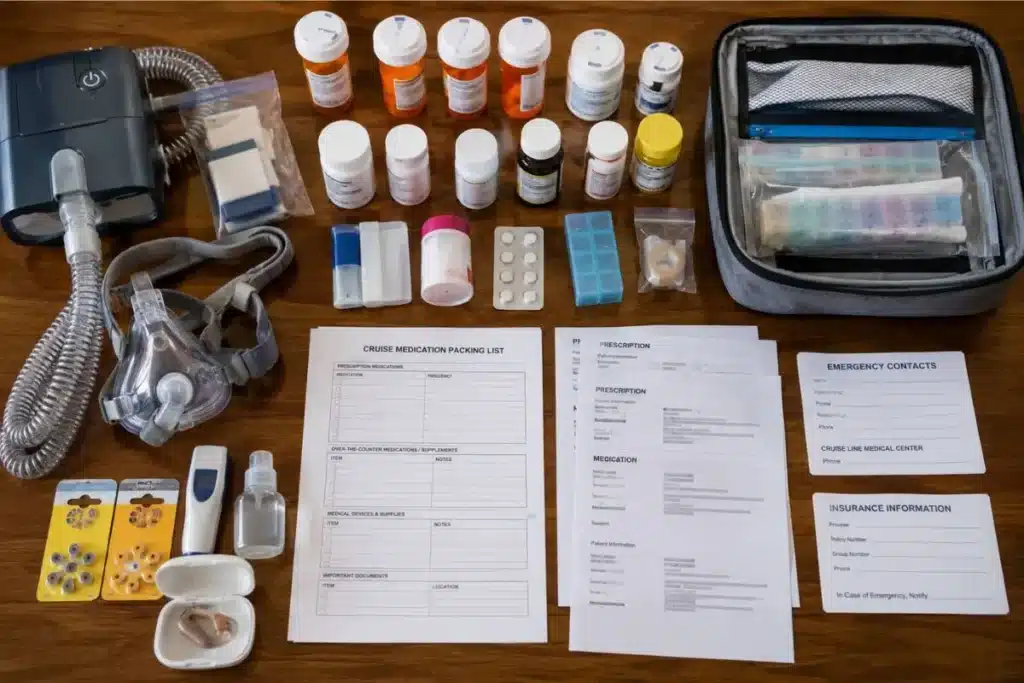
Here is the system I use now. It is plain, but plain works wonderfully at sea.
| Category | What to pack | Why it matters |
|---|---|---|
| Daily prescriptions | Enough for the full cruise plus extra days | Delays, reroutes, and lost bags happen |
| Original containers | Labeled bottles with your name and dosage | They help explain what the medicine is |
| Written prescriptions | Printed list with generic names | Useful if medicine is lost or questioned |
| Over the counter medicine | Pain relief, stomach medicine, antihistamine, motion sickness medicine | Ship shops may be limited and expensive |
| Medical devices | CPAP supplies, glucose supplies, hearing aid batteries, chargers | Small missing parts can become large problems |
| Cooling supplies | Approved cold pack or insulated pouch when needed | Some medicines are temperature sensitive |
| Emergency information | Doctor contacts, insurance card, allergies, conditions | Helps ship medical staff act faster |
Cruise medication checklist for seniors
For seniors, the real issue is not just what to bring. It is how to make the medicine understandable to someone else if you become tired, confused, delayed, or separated from your cabin bag.
- Prescription medicines in original labeled containers.
- A printed medicine list with dose, schedule, and prescribing doctor.
- Enough medicine for the trip plus several extra days.
- Over the counter basics approved by your physician or pharmacist.
- Medical device supplies, batteries, cords, and adapters.
- Copies of prescriptions and insurance information.
- A note from your doctor for controlled, injectable, or unusual medicines.
- A small daily organizer filled only after you have packed the original bottles.
For broader age specific packing choices, I also recommend keeping this beside my cruise packing list for seniors, because medicine, mobility, shoes, documents, and cabin comfort tend to overlap more than people expect.
What belongs in your carry on
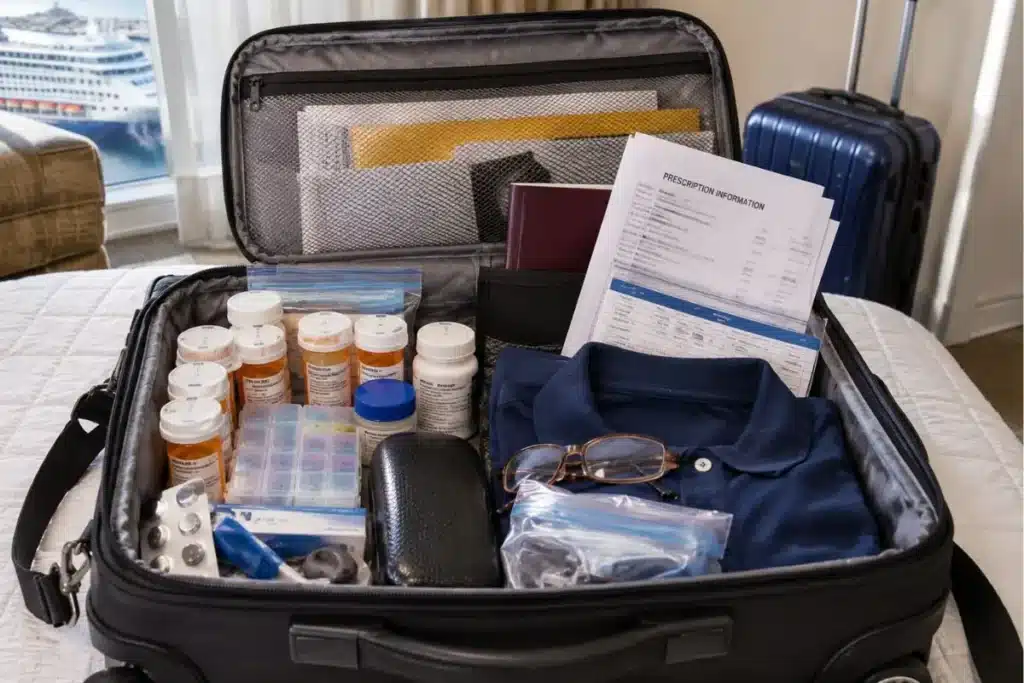
Your essential medicines belong in your carry on, not in checked luggage. This is the one thing I wish someone had told me before my first long cruise.
Checked bags usually arrive. Most of them. But I have seen bags miss the ship, arrive two days late, or sit in the wrong hallway while the passenger paced with a tight jaw.
I keep daily prescriptions, emergency medicines, medical documents, glasses, hearing aid supplies, and one change of clothing in my carry on. If the suitcase disappears, I can still function.
Liquid medicines and airport security
If you fly to your cruise port, check current TSA rules before you leave home. Rules can change, and airport screening is not the place to discover that your plan depended on old information.
For liquid medicines, refrigerated medicines, needles, lancets, or medical devices, I prefer to arrive early and keep everything easy to inspect. I do not bury medical items under shoes, snacks, and a novel I swear I am finally going to finish.
Documents and prescriptions to bring
Bring written proof of what you take, especially on international cruises. The U.S. State Department warns that some countries have rules about medications, and a prescription bottle alone may not always be enough.
The State Department’s cruise guidance says travelers should check whether medications are legal in each country visited, carry a written copy of prescriptions, and have enough prescription medication beyond trip dates in case of delays. I treat that as a minimum, not a formality, and you can review the official State Department cruise ship guidance before you sail.
For cruises with foreign ports, I also keep copies of my passport photo page, travel insurance, and emergency contacts. A medicine list without a way to reach your doctor is only half a system.
What your medicine document should include
- Your full name and date of birth.
- Each medicine name, including generic and brand names.
- Dosage and timing.
- Reason the medicine is prescribed.
- Prescribing doctor and phone number.
- Pharmacy name and phone number.
- Allergies and major medical conditions.
- Emergency contact at home.
A retired physician who once sailed the Danube with us gave me advice I still follow: keep this list boring. Her exact point was that emergency information is not the place for clever formatting.
How to handle storage and timing
Storage and timing should be decided before you board, not after you unpack. Some medicines do poorly with heat, cold, humidity, or casual guesses.
The CDC notes that extreme temperatures can reduce the effectiveness of many medicines and recommends finding out how to store medicine safely while traveling. I ask the pharmacist, then I write the answer down.
If a medication needs refrigeration, call the cruise line before final payment if possible, and again before sailing. Ask whether your cabin has a true refrigerator or a cooler, and ask what the medical center can support.
Time zones and dosing schedules
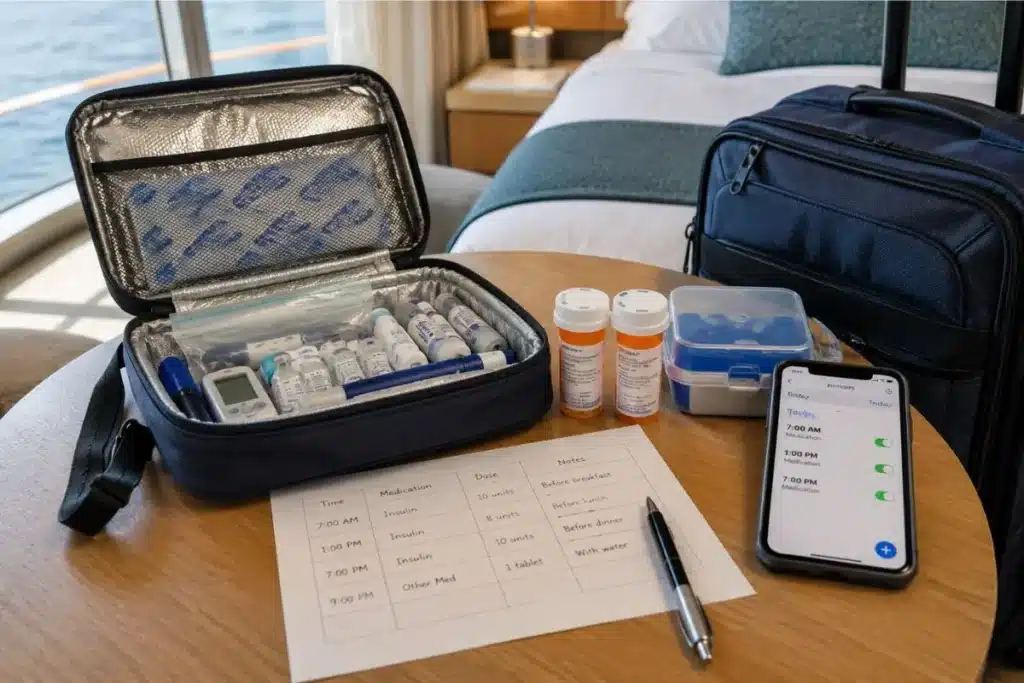
Time zone changes can make dosing confusing. The CDC advises asking your healthcare provider about timing changes, because some medicines should be taken according to time since the last dose rather than local clock time.
I set phone reminders before we leave home. Then Margaret makes me check them again, because marriage is sometimes just quality control with better coffee.
Common mistakes seniors make
The most common medication mistakes are simple ones. That is what makes them so frustrating.
The first mistake is packing only the exact number of pills needed. A missed flight, storm delay, itinerary change, or quarantine can turn exact into insufficient very quickly.
The second mistake is relying only on a pill organizer. Organizers are useful in the cabin, but original labeled containers and written prescriptions are better when someone needs to identify what you take.
The third mistake is assuming every port has the same over the counter medicines you use at home. Some do. Some do not. And even when they do, the brand name may be unfamiliar.
The fourth mistake is waiting until the night before departure to ask for refills. Pharmacies, insurance rules, and doctors’ offices do not always move at cruise passenger speed.
The fifth mistake is forgetting medical devices. CPAP hoses, charging cords, hearing aid batteries, glucose strips, and spare glasses are not glamorous, but neither is trying to replace them in a port shop.
Arthur’s verdict
My verdict is simple: treat medicine packing as its own project, not as the last corner of your suitcase. A careful cruise medication packing list is one of the least exciting things you will prepare, and one of the most important.
If you take one or two routine prescriptions, you still need original containers, extra days, and a printed list. If you take several medicines, use injectables, need refrigeration, use oxygen or CPAP, or have a serious condition, speak with your physician, pharmacist, and cruise line before you sail.
For me, peace of mind begins with a small folder, a labeled pouch, and enough medicine to handle delay without panic. Not dramatic. Just sensible.
Want tips like these every week?
Arthur & Margaret share honest cruise reviews, senior-friendly port guides, and exclusive deals — straight to your inbox. 2,000+ readers. No spam.
Questions I’m often asked
These are the questions I hear most often from readers, friends, and the occasional nervous dinner companion on embarkation night.
Should I pack cruise medicines in my carry on or checked bag?
Pack essential medicines in your carry on. Checked luggage can be delayed, misplaced, or unavailable when you need your next dose.
Do I need original prescription bottles for a cruise?
Yes, I recommend original labeled containers, especially for international cruises. The CDC recommends keeping medicines clearly labeled with your name, provider, medicine name, and dosage.
How many extra days of medicine should I bring?
Ask your physician or pharmacist, but I never bring only the exact number of doses. Delays are common enough that extra days are sensible.
Can I bring over the counter medicine on a cruise?
Usually, yes, but check rules for your airline, cruise line, and destination countries. Ask your pharmacist about interactions with prescriptions before adding anything new.
What if my medication is controlled or injectable?
Ask your doctor for documentation before travel. The CDC specifically recommends a note from the prescribing provider for controlled substances or injectable medicines such as EpiPens and insulin.
Can the cruise ship replace my medication?
Do not count on it. Ship medical centers are not floating versions of your home pharmacy, and foreign ports may not carry the same medicine or dosage.