Best Mediterranean cruise itinerary: the route I’d choose first
My daughter Claire once asked me for the best mediterranean cruise itinerary while holding a notebook full of underlined city names. Barcelona, Rome, Florence, Athens, Santorini, Dubrovnik, Venice. It looked less like a vacation and more like a graduate exam in European civilization.
I told her to slow down. A Mediterranean cruise is not won by collecting ports. It is won by choosing the right rhythm.
I’m Arthur Pendleton, 68 years old, a retired history professor, and the voice behind ElderTrip.com. If I were choosing a first Mediterranean route for most seniors, I would start with Barcelona, southern France, coastal Italy, one carefully planned Rome or Florence day, and a calmer Adriatic finish if the itinerary allows it.
In this guide
- Before you choose: decide how hard you want the trip to work
- Best Mediterranean cruise itinerary for most seniors
- How the main Mediterranean itinerary types compare
- Ports I would balance carefully
- Common mistakes seniors make with Mediterranean itineraries
- Arthur’s verdict
- Questions I’m often asked
Before you choose: decide how hard you want the trip to work
The first decision is not Western Mediterranean or Greek islands. The first decision is how much walking, heat, bus time, tendering, and daily sightseeing your body will enjoy.
Let me be direct about this. A cruise itinerary can look magnificent on paper and become exhausting in practice. Rome from Civitavecchia, Florence from Livorno, and Athens from Piraeus are all rewarding, but they are not light days.
Rick Steves’ Mediterranean cruise material emphasizes making the most of limited time ashore in places such as Barcelona, the French Riviera, Florence, Rome, Venice, Dubrovnik, Athens, the Greek Isles, and Istanbul. That limited-time idea is the phrase seniors should underline.
If you are building your first route, read the broader destination hub once it is published: mediterranean cruise. The itinerary is the skeleton of the whole trip.
The best itinerary has recovery built in
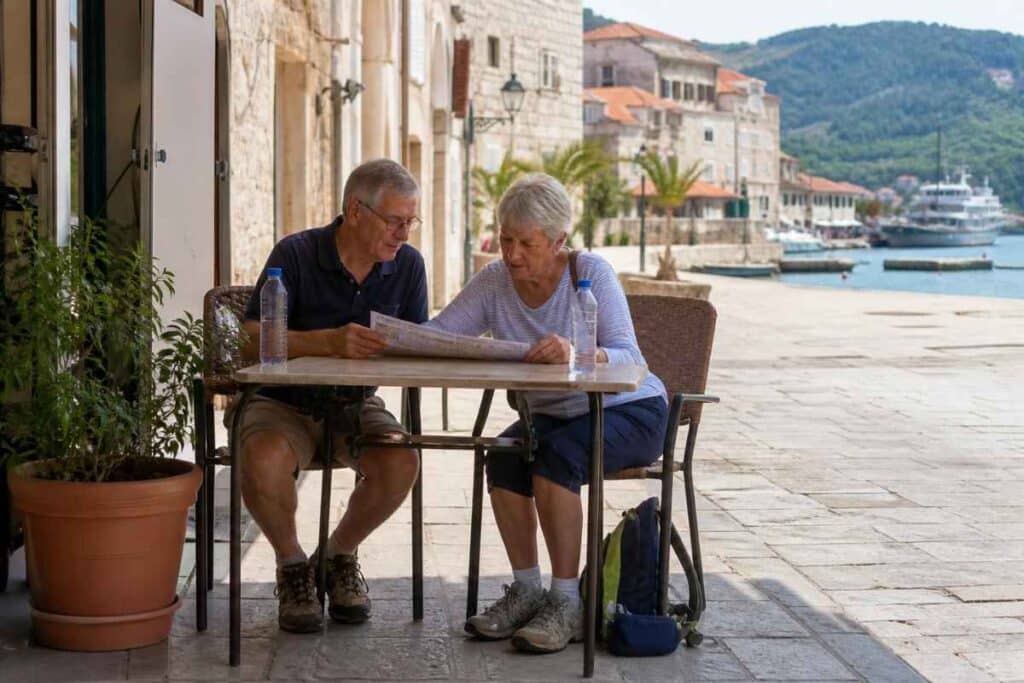
I like at least one sea day on a Mediterranean cruise longer than a week. Not because I dislike ports. Because I like enjoying them.
A sea day after Naples, Rome, Florence, or Athens gives older travelers time to rest, do laundry, eat slowly, and return to the next port with some goodwill left in the knees.
Best Mediterranean cruise itinerary for most seniors
The best Mediterranean cruise itinerary for most seniors is a 10 to 14 day route that starts or ends in Barcelona, includes southern France, visits coastal Italy with one major long transfer day, and adds one or two Adriatic ports such as Dubrovnik or Split.
That route gives you architecture, food, art, Roman history, sea views, and old towns without making every day equally demanding. It also lets you choose whether Rome or Florence gets the heroic effort, rather than trying to make every Italian stop a masterpiece.
Viking’s Mediterranean Odyssey itinerary is a useful example of the classic sweep, listing 13 days, 10 guided tours, and six countries, with ports including Barcelona, Marseille, Monte Carlo, Florence or Pisa through Livorno, Rome through Civitavecchia, Naples, Corfu, Dubrovnik, Split, and Venice or Chioggia.
I would not say every senior should book that exact route. I would say it shows the kind of balanced Mediterranean arc I like: Spain, France, Italy, a sea day, and the Adriatic or Greek side for texture.
Why Barcelona is such a good start
Barcelona is one of the easiest major Mediterranean cities for starting or ending a cruise. It has serious airport connections, hotels, taxis, food, and enough sights to justify arriving two nights early.
Port de Barcelona explains that Adossat pier cruise terminals connect with the city center by the T3 Portbus, while World Trade Center terminals sit close to public transport. That kind of transport clarity matters after a long flight.
How the main Mediterranean itinerary types compare
The Mediterranean breaks into several practical itinerary types. Western Mediterranean routes are usually best for first timers, Adriatic routes are often underrated, and Greek island routes are beautiful but can be harder for mobility and heat.
| Itinerary type | Typical ports | Best for | Main caution | Arthur’s senior verdict |
|---|---|---|---|---|
| Western Mediterranean | Barcelona, Marseille, Livorno, Civitavecchia, Naples | First timers, art, food, major cities | Long Italy transfers | Best starting route |
| Adriatic | Dubrovnik, Split, Kotor, Zadar, Venice area | Old towns, coastlines, history | Cobblestones and summer crowds | Excellent with slower pacing |
| Greek islands | Santorini, Mykonos, Rhodes, Corfu, Crete | Views, island culture, ancient sites | Tenders, steps, heat | Beautiful but less forgiving |
| Eastern Mediterranean | Athens, Kusadasi, Istanbul, Rhodes | Ancient history and layered culture | Heat and walking intensity | Best with guided excursions |
| Long grand voyage | Barcelona to Athens or Istanbul, many countries | Travelers with time and stamina | Fatigue from repeated port days | Only if there are rest days |
Kiplinger’s retiree cruise guidance highlights lines such as Holland America, Viking, Silversea, Cunard, and Oceania for older travelers, with advice to book early, stay flexible, and check mobility accommodations. That is sound advice, but the itinerary still decides the daily experience.
If Viking is already on your shortlist, my guide to viking mediterranean cruises explains how its included excursions, ship atmosphere, and Mediterranean routes work for seniors.
Adriatic routes deserve more attention
The Adriatic often gives seniors a better emotional return than they expect. Split, Dubrovnik, Kotor, Zadar, and the Venice area offer compact history and coastal beauty without always requiring the same transfer burden as Rome or Florence.
That does not mean the Adriatic is easy in every direction. Dubrovnik stones can be slick, Kotor can be crowded, and summer heat still matters. But the scale can feel more humane than trying to conquer Rome in one day.
Ports I would balance carefully
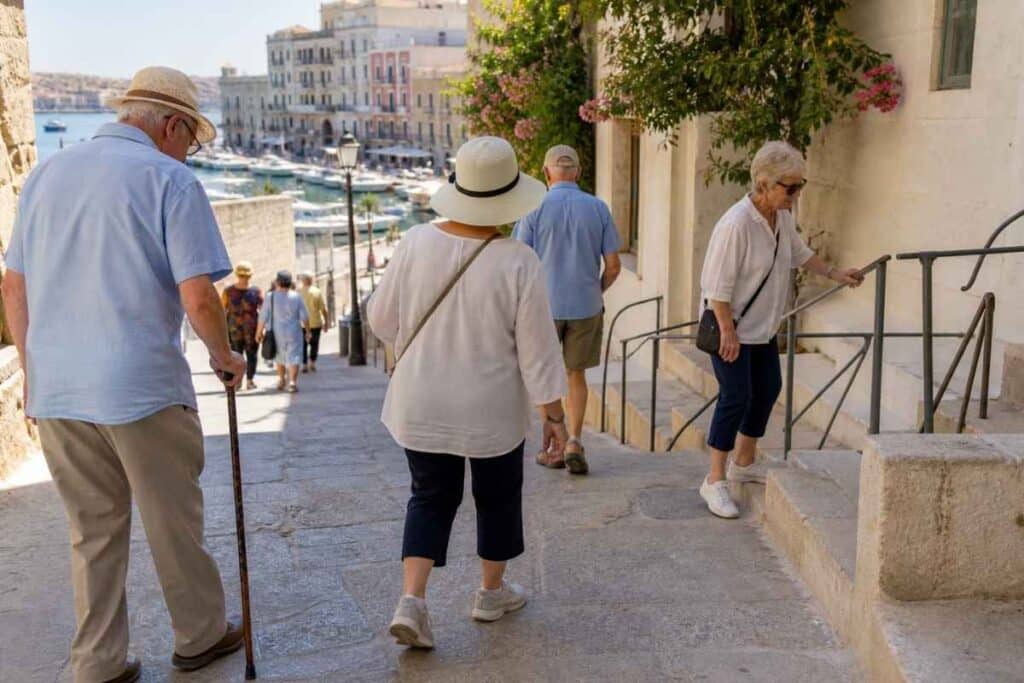
The ports to balance carefully are the famous long days: Rome, Florence, Naples, Athens, Santorini, and sometimes Venice area embarkation or disembarkation. They can be superb. They can also take more energy than expected.
Rome through Civitavecchia is worth doing if Rome matters to you. But do not stack it casually between two other hard days. Florence through Livorno deserves the same respect.
Santorini is a different kind of challenge. Rick Steves’ Greek Islands cruise material describes Santorini as a dramatic caldera island with villages high on the rim. That is exactly why people dream of it, and exactly why travelers with knee or balance concerns need to study the tender and uphill logistics before booking.
Athens from Piraeus is wonderful for travelers who care about ancient history. But the Acropolis is exposed, uneven, and hot in summer. I would choose an early, guided, well paced tour rather than trying to improvise it after breakfast.
Choose one heroic day, not five
Every Mediterranean cruise can afford one heroic day. Perhaps Rome. Perhaps Florence. Perhaps Athens. Choose the one that matters most, then build gentler days around it.
Margaret calls this “saving the good legs.” She is right. Good legs are not unlimited, and neither is patience in August heat.
Common mistakes seniors make with Mediterranean itineraries
The first mistake is choosing the itinerary with the most countries. More countries can mean more variety, but it can also mean more logistics, more buses, and less time to feel where you are.
The second mistake is ignoring embarkation and disembarkation. Barcelona is often simpler than Venice area ports for many North American travelers. Rome and Athens can work well too, but airport and port transfers deserve attention.
The third mistake is booking July or August without thinking about heat. The Mediterranean is not just warm in midsummer. It can be punishing on stone streets and exposed ruins.
The fourth mistake is trusting a route map more than the day by day schedule. A map shows romance. The schedule shows whether you have five port days in a row and a 7:30 a.m. bus three mornings running.
The fifth mistake is treating tender ports as a minor detail. If you use a cane, walker, rollator, wheelchair, or scooter, ask about tender procedures before booking. A beautiful island is less useful if you cannot comfortably get ashore.
Arthur’s verdict
My best Mediterranean cruise itinerary for most seniors would be 10 to 14 days, starting in Barcelona, moving through southern France and coastal Italy, including one major Rome or Florence day, adding a sea day, and finishing with Dubrovnik, Split, or Venice area ports.
If this is your first Mediterranean cruise, choose Western Mediterranean with a touch of Adriatic. If you have already seen Rome and Florence, lean toward the Adriatic or a quieter eastern route. If your heart is set on the Greek islands, choose May, early June, September, or October and respect the tender ports.
The best Mediterranean cruise itinerary is not the one that impresses your friends at home. It is the one that lets you come home with stories you were comfortable enough to notice.
Want tips like these every week?
Arthur & Margaret share honest cruise reviews, senior-friendly port guides, and exclusive deals — straight to your inbox. 2,000+ readers. No spam.
Questions I’m often asked
These are the itinerary questions I hear most often from readers trying to choose between a dozen beautiful routes.
What is the best Mediterranean cruise itinerary for first timers?
I would choose a Western Mediterranean route from Barcelona with southern France, coastal Italy, one carefully planned Rome or Florence day, and perhaps an Adriatic finish. It gives variety without being too specialized.
Is Western or Eastern Mediterranean better for seniors?
Western Mediterranean is usually the easier first choice. Eastern Mediterranean routes can be wonderful for ancient history, but Athens, Greek islands, Turkey, heat, and tender ports may require more planning.
Are Greek island itineraries good for older travelers?
They can be, but choose carefully. Santorini and some island ports involve tenders, steps, slopes, and crowds. If mobility is a concern, study each port before you book.
How many days should a Mediterranean cruise be?
For many seniors, 10 to 14 days is the sweet spot. Shorter cruises can feel rushed, while longer ones need sea days and a gentle rhythm to avoid fatigue.
What month is best for a Mediterranean cruise itinerary?
May, early June, September, and October are my preferred months for many seniors. July and August bring heat and crowds that can make walking days much harder.
A Mediterranean itinerary should feel like a conversation with the region, not a race through it. Choose the route that gives you time to sit, look, eat, listen, and return to the ship before your good humor disappears. That is where the real trip lives.