
Cruise Hidden Fees: Every Charge You Need to Budget for in 2026
My daughter-in-law carol came off her first cruise looking like she’d seen a ghost. not a frightening ghost. more the kind that appears at the end of a seven-night caribbean sailing when you discover the number on your final onboard statement is $680 more than you’d mentally budgeted.
Carol is not a careless person. she’d researched the base fare, planned her shore excursions, and even looked up the daily gratuity charge. what she hadn’t accounted for was everything else.
The wi-fi package she bought on day one. three specialty dinners. two spa treatments. bottled water from the mini bar. a photography package bought at a discount on night six. all of it added up quietly, the way small things do when you’re enjoying yourself and not watching.
Cruise hidden fees are not exactly hidden. every charge carol paid was disclosed somewhere in the booking terms. but they’re easy to miss when you’re focused on the excitement of the trip itself. after more than 50 voyages, i’ve learned to budget for all of it before i board. here is the complete list.
In this guide
- mandatory charges you cannot avoid
- common extras most passengers pay
- new charges introduced in 2026
- fees that are easy to avoid
- full fee comparison table
- arthur’s verdict
- questions i’m often asked
Mandatory charges you cannot avoid
These are not technically cruise hidden fees because the cruise lines disclose them. but they are consistently underestimated in initial budget planning, and they apply regardless of how you travel or what you buy onboard.
Port fees and government taxes
Every port your ship visits charges a docking fee, which is passed directly to passengers. governments of the countries you visit add their own taxes on top. on most mainstream american cruise lines, the advertised base fare does not include these charges. they appear during checkout when you book.
A seven-night caribbean sailing with four port stops typically adds $150 to $400 per person in port fees and taxes. mediterranean and alaska itineraries generally run higher. always check the “total price” figure during booking rather than the headline fare to see what you will actually pay.
Automatic daily gratuities
As of mid-2026, mainstream cruise lines charge between $17 and $20 per person per night in automatic crew appreciation fees. on a seven-night sailing for two people, that is $238 to $280, added automatically to your onboard account.
I cover these in full detail in my guide to cruise gratuities, including which lines raised rates in 2026 and why prepaying before you board is almost always the right move.
Common extras most passengers pay
These charges are optional in the sense that you don’t have to buy them. but most cruisers end up paying at least some of them, and not accounting for them beforehand leads to carol’s situation on disembarkation morning.
Wi-fi packages
Cruise ship wi-fi has improved dramatically since starlink’s adoption across most major fleets in 2024 and 2025. speeds now support video calls and streaming on many ships. prices have risen alongside the improvement.
In 2026, expect to pay $20 to $35 per device per day for a streaming-capable package when purchased before sailing. buying the same package onboard costs 30% to 50% more. basic social media and email plans start around $15 to $20 per day.
On a seven-night sailing, a couple paying for two devices on a mid-tier plan can spend $280 to $490 on wi-fi alone.
One note for seniors who want to stay in touch with family: put your phone on airplane mode before you board and reconnect only via the ship’s wi-fi package. your phone will otherwise attempt to connect to foreign cellular networks the moment you step ashore at a foreign port. cellular roaming at sea and in international ports can generate bills that make every other charge on this list look small.
Specialty dining
Your base fare covers the main dining room and buffet on almost every mainstream cruise line. specialty restaurants, the steakhouses, sushi bars, italian trattorias, and chef’s tables you’ll see advertised throughout the ship, carry an additional cover charge.
Typical charges run from $25 to $55 per person per meal, plus an automatic 18% to 20% service charge on top. a couple doing two specialty dinners during a seven-night sailing can spend $120 to $200 on those meals before the service charge is added.
Beverages and drink packages
Water, basic coffee, tea, and juice are included on most mainstream lines. alcoholic beverages, specialty coffees, sodas, and premium waters are not. individual drinks cost $8 to $15 each, plus the automatic service charge.
Drink packages cost $60 to $100 per person per day on mainstream lines. whether that makes sense depends entirely on how much you drink. i address this in full in my guide to cruise drink packages, including the break-even math by cruise line. the short answer for most seniors: pay per drink unless you genuinely consume six or more drinks daily.
Shore excursions
Shore excursions booked through the cruise line run from $50 for a basic bus tour to over $300 for helicopter flights or glacier hikes in alaska. a couple doing one cruise-line excursion at each of four ports on a caribbean sailing can spend $400 to $800 on shore activities.
Independent operators at the same ports typically charge 30% to 50% less for comparable tours. the trade-off is that cruise-line excursions guarantee the ship will wait if you run late. independent tours carry no such guarantee, and missing the ship is not a hypothetical outcome.
Spa services
A 50-minute massage on a cruise ship costs $130 to $180, plus an automatic 18% to 20% service charge. port-day discounts of 10% to 20% are frequently offered in the morning when the spa is quiet and most passengers are ashore.
If you plan to use the spa, check the daily program for port-day specials rather than booking the first evening you board, when standard rates apply.
New charges introduced in 2026
Several cruise lines introduced new or expanded charges during 2026. these are the ones most likely to surprise passengers who haven’t sailed recently or who are relying on information from older articles.
- norwegian cruise line main dining: a $5 per-entree fee now applies to any main course ordered beyond the first two at a sitting. norwegian frames this as a food waste measure, but passengers used to ordering freely now face a direct per-plate charge in standard dining venues.
- norwegian beverage packages on private islands: norwegian initially announced that prepaid drink packages would no longer be valid at great stirrup cay from march 2026. following significant guest feedback, norwegian reversed this decision. as of march 2026, prepaid packages continue to cover drinks on the island as they do onboard.
- cunard room service afternoon hours: complimentary room service now ends at 10 a.m. on cunard ships. orders later in the day carry a service fee, a meaningful change for a line that built part of its brand on traditional full-service hospitality.
- wi-fi price increases: carnival quietly raised pre-purchase wi-fi prices in late 2025. disney raised prices in early 2026. neither announced the changes in advance. pre-purchase your wi-fi package as early as possible to lock in the rate showing at the time of booking.
Fees that are easy to avoid
Some charges that look inevitable have simple workarounds that most first-time passengers don’t know about until their second voyage.
- onboard pharmacy markups: cruise ship pharmacies charge significantly more than land prices for common medications, sunscreen, seasickness remedies, and over-the-counter pain relievers. bring everything you could reasonably need from home, plus a 30-day surplus beyond the length of your sailing. this is especially important for passengers on regular prescriptions.
- mini bar items: mini bar beverages in your cabin are priced at rates that make airport convenience stores look reasonable. clear the mini bar contents into a drawer when you board if you don’t plan to use it, so nothing is accidentally consumed. a bottle of still water from a royal caribbean mini bar costs over $5. the same bottle costs under $2 at most port stops.
- photography packages: the shipboard photographer offers package discounts partway through the voyage. wait until the last day, when discounts are usually steeper, before buying. or simply purchase individual prints of the photos you genuinely like rather than a bulk package of images you’ll never look at.
- fitness classes: the gym itself is free on almost every cruise ship. organized classes with an instructor, including yoga, pilates, and spinning, typically cost $10 to $15 per session. free stretching and cardio equipment is available at no charge at any hour.
Full fee comparison table
| charge type | typical amount (per person) | avoidable? | best strategy |
|---|---|---|---|
| port fees and taxes | $150 to $400 per sailing | no | check total price at booking, not headline fare |
| automatic gratuities | $17 to $20 per night | technically possible, but strongly discouraged | prepay before sailing to lock in current rate |
| wi-fi (mid-tier, one device) | $20 to $35 per day | yes | buy the pre-cruise package, save 30% to 50% |
| specialty dining | $25 to $55 per meal plus 18% to 20% | yes | budget for one or two, the main dining room is genuinely good |
| beverages (individual drinks) | $8 to $15 per drink plus service charge | yes | pay per drink unless you consume 6 or more drinks daily |
| shore excursions | $50 to $300 per excursion | yes | compare independent operators, save 30% to 50% |
| spa services | $130 to $200 per treatment | yes | book on port days for 10% to 20% discount |
| fitness classes | $10 to $15 per class | yes | use the free gym, skip instructor-led classes |
| onboard photos | $20 to $400 for packages | yes | buy individual prints you love, wait for last-day discounts |
| mini bar items | $3 to $8 per item | yes | clear mini bar on arrival, bring snacks and water from home |

Arthur’s verdict
The honest answer to “how much do cruise hidden fees add to the total?” is between $400 and $1,200 for a couple on a seven-night mainstream sailing, depending on how many extras you buy. that is not a small number.
It is also not a reason to avoid cruising. it is a reason to plan honestly before you board rather than discovering the total as you hand back your key card.
My pre-cruise budget always includes port fees, gratuities prepaid, one wi-fi package bought before boarding, two specialty dinners, and a daily allowance for drinks and small purchases. everything else i treat as a decision i’ll make during the voyage with a clear head, not an impulse charge at the spa desk at 8 p.m. on the first evening.
For the base fare numbers by cabin type and cruise line, see my complete guide to how much does a cruise cost. that article covers what the booking page shows you. this one covers what gets added on top.
Want tips like these every week?
Arthur & Margaret share honest cruise reviews, senior-friendly port guides, and exclusive deals — straight to your inbox. 2,000+ readers. No spam.
Want tips like these every week?
Arthur & Margaret share honest cruise reviews, senior-friendly port guides, and exclusive deals — straight to your inbox. 2,000+ readers. No spam.
Questions i’m often asked
Are cruise hidden fees the same on every cruise line?
No, and the differences matter considerably. luxury all-inclusive lines like regent seven seas, silversea, and seabourn include gratuities, drinks, wi-fi, and most specialty dining in the base fare. viking ocean includes gratuities and most non-alcoholic beverages but charges separately for alcohol and wi-fi.
Mainstream lines charge separately for nearly everything on this list. when comparing a luxury line to a mainstream line, the true cost gap is usually narrower than it appears once you add the extras back into the mainstream fare.
Can i bring my own beverages onboard to save money?
Most cruise lines allow passengers to bring a limited quantity of wine or champagne onboard in carry-on luggage at embarkation. carnival and royal caribbean each permit one bottle of wine or champagne per person of legal drinking age.
If you open that bottle in a restaurant or bar, some lines charge a corkage fee of $15 or more per bottle. spirits and beer are generally not permitted. confirm the policy for your specific line before you pack.
What’s the best way to avoid a surprise bill at checkout?
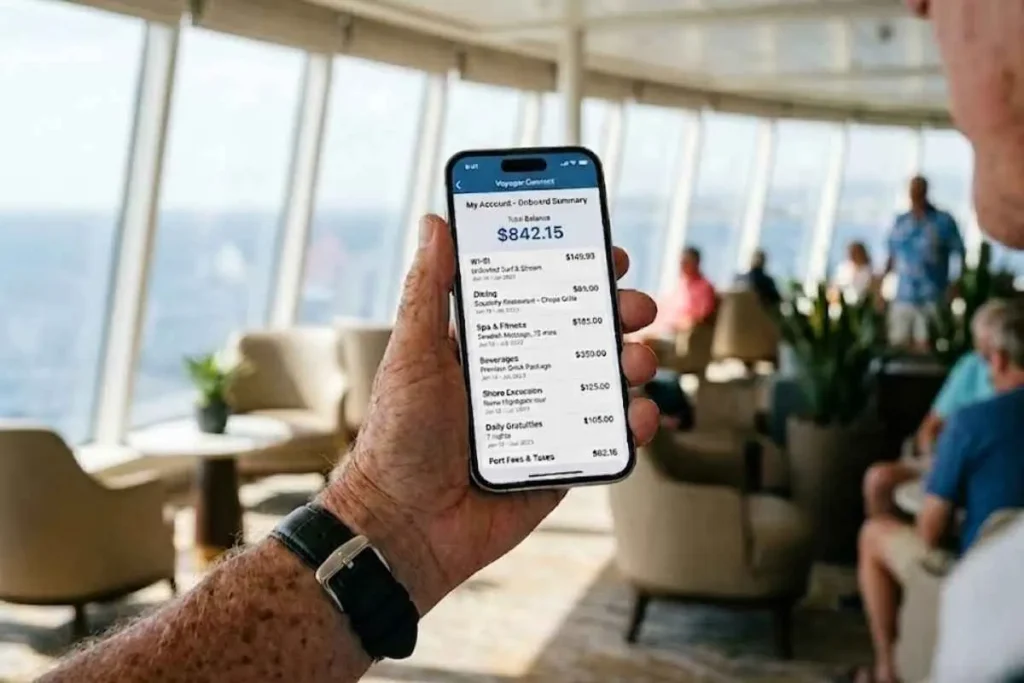
Check your running onboard account in the cruise line’s mobile app every morning. it takes 30 seconds and removes all possibility of a checkout surprise. most lines also let you request a printed statement at guest services at any point during the voyage.
I do both: check the app daily and request a printed statement two days before disembarkation, which gives me time to review any charges i don’t recognize before the desk crowds on the final morning.
Do cruise ships charge for medical care onboard?
Yes. shipboard medical centers operate like private urgent care clinics and charge accordingly. a basic physician consultation typically runs $100 to $200. more serious treatments and tests cost substantially more.
Medical evacuation from a ship to the nearest port hospital can cost tens of thousands of dollars without insurance. this is the primary reason cruise travel insurance with strong medical and evacuation coverage is strongly recommended for all seniors. please consult your physician or insurance advisor about the right coverage for your situation before sailing.
Are there costs i should budget for before i even get to the port?
Yes. transportation to and from the port adds to the real cost of any sailing, whether you’re driving, flying, or taking a shuttle. arriving the day before embarkation is strongly recommended if you’re flying, which means a pre-cruise hotel night and dinner in the port city.
Parking at major cruise terminals runs $15 to $30 per day for the length of your voyage. checked baggage fees on flights add further cost. none of these appear on the cruise line’s website, but all of them are as real as the base fare.
Final thoughts
Cruise hidden fees are not a trap if you know they’re coming. they are a feature of a pricing model that advertises a low entry cost and charges separately for the things most passengers choose to add.
Once you understand the structure, you can budget for it honestly and enjoy the voyage without the anxiety of a running mental tally.
Carol sailed again the following spring. she had a spreadsheet this time. she came off the ship pleased rather than pale, which is exactly the outcome worth planning for.
