

How Much Does a Cruise Cost in 2026? Arthur Pendleton’s Complete Guide
My friend tom called me with a question that i’ve since been asked in one form or another by everyone planning their first cruise: how much does a cruise cost?
He’d found a fare he liked. seven nights in the caribbean, a mainstream line, inside cabin, two adults. the website showed $978 for both of them. he was ready to book.
Three months later, tom and his wife spent $3,200 on that cruise. not because they were extravagant. because they hadn’t planned for everything the $978 didn’t include.
How much does a cruise cost is a question that deserves an honest, complete answer rather than a headline fare. i’ve taken more than 50 voyages across four continents over 12 years. i’ve booked inside cabins and suites, sailed in hurricane season and high summer, and made every budgeting error worth making. this guide covers everything.
In This Complete Guide
- What the base fare includes and what it doesn’t
- Base fares by cabin type and cruise line
- Mandatory extra costs: port fees and gratuities
- Common onboard extras most passengers pay
- When you book affects what you pay
- Solo travelers: the single supplement
- Real budget examples by traveler type
- What makes cruising worth it for seniors
- Arthur’s master verdict
- Questions i’m often asked
What the Base Fare Includes and What It Doesn’t
The base cruise fare covers your cabin, all meals in the main dining room and buffet, entertainment including shows and pool access, the ship’s gym, and basic non-alcoholic beverages: tap water, coffee, tea, and juice at the buffet.
That is a genuinely substantial package for the price. it is why cruising compares favorably to hotel-based vacations when you calculate accommodation, meals, and entertainment separately.
What the base fare does not include is the longer and more financially significant list. port fees and government taxes. automatic daily gratuities. alcoholic beverages and specialty coffees. wi-fi. shore excursions. specialty dining restaurants. spa services. room service fees on most lines.
These are not hidden fees in the sense of being secret, but they are consistently underestimated because most people build their mental budget around the headline fare and fill in the rest on the ship.
My friend gene, a retired engineer, built a spreadsheet before his first cruise. every anticipated expense in one column, every anticipated day. he was the only member of our group who wasn’t surprised at checkout. take a lesson from gene. i will give you every number he put in that spreadsheet.
Base Fares by Cabin Type and Cruise Line
Cabin type is the single most variable element in the base fare. the four main categories, from least to most expensive, are interior, oceanview, balcony, and suite.
On a seven-night caribbean sailing in 2026, here is what to expect at base fare per person before any extras:
| Cabin type | Budget lines (carnival, msc) | Mid-range (holland america, princess) | Premium/luxury (viking, regent) |
|---|---|---|---|
| Interior (no window) | $350 to $700 | $700 to $1,200 | Not typically offered |
| Oceanview (window, no balcony) | $500 to $900 | $900 to $1,500 | Not typically offered |
| Balcony (private outdoor space) | $700 to $1,400 | $1,100 to $2,200 | $2,500 to $6,000+ |
| Suite | $1,500 to $4,000 | $2,500 to $6,000 | $3,000 to $15,000+ |
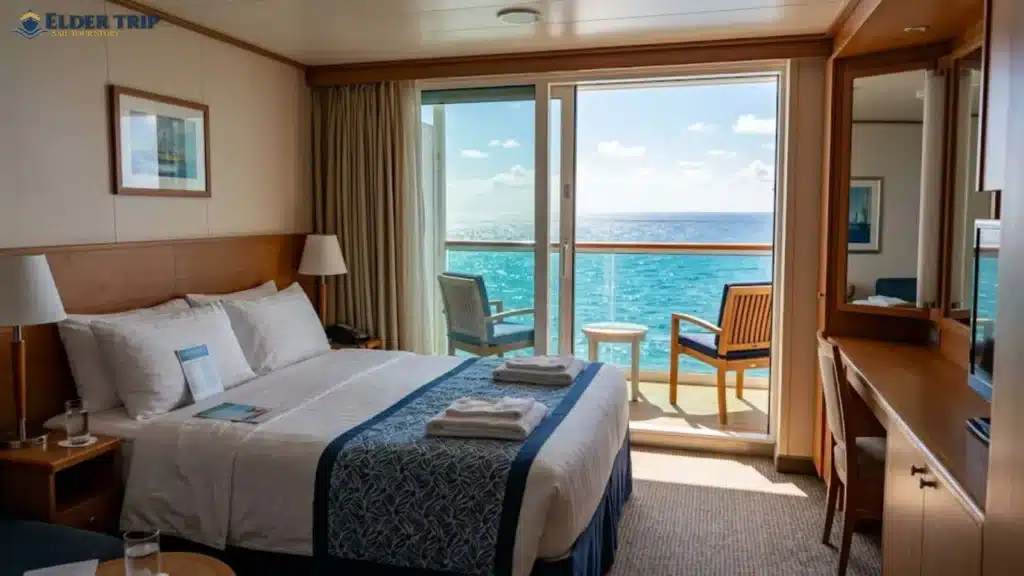
The balcony question deserves a direct answer. if the ship is the destination or the scenery is moving past your window all day, the balcony premium is justified. alaska and norway are the clearest examples. if you spend your days ashore and your cabin is where you sleep, an oceanview saves you $400 to $700 per cruise without meaningful sacrifice.
Mandatory Extra Costs: Port Fees and Gratuities
Two charges are essentially unavoidable on mainstream cruises and must be added to any realistic budget from the first day of planning.
Port fees and government taxes
These are charged by the ports and governments your ship visits and passed directly to passengers. most mainstream american cruise lines do not include these in the advertised base fare.
They appear at checkout when you book. on a seven-night caribbean sailing, expect $150 to $400 per person. mediterranean and alaska itineraries typically run higher. always look at the “total price” figure, not the headline fare.
Automatic daily gratuities
Five major cruise lines raised their gratuity rates in the first half of 2026. current rates run from $17 per person per night on carnival to $20 per person per night on norwegian.
On a seven-night sailing for two people in a standard cabin, the gratuity charge is now $238 to $280, added automatically to your onboard account daily whether or not you visit the main dining room.
Prepaying gratuities before you board locks in the rate currently in effect and removes daily account tracking from your vacation. i cover every line’s current rates, the 2026 increases, and the question of whether you can remove them in my complete planning guide.
Common Onboard Extras Most Passengers Pay
These are optional in the technical sense. in practice, most cruisers pay some or all of them. not planning for them is the primary reason disembarkation bills surprise people.
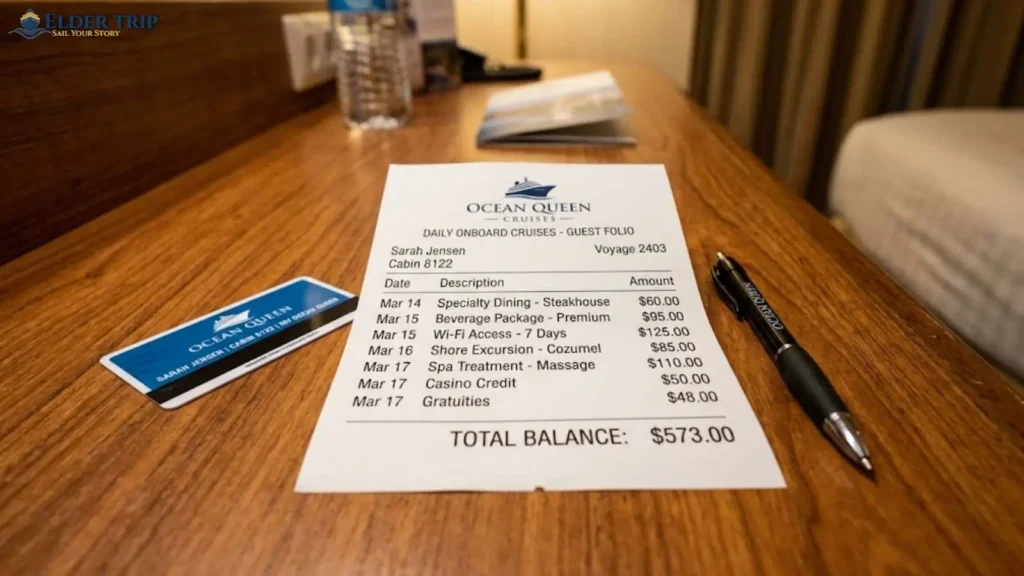
Wi-fi
Cruise ship wi-fi has improved significantly since most major lines adopted starlink technology in 2024 and 2025. a mid-tier package covering streaming and video calls now costs $20 to $35 per device per day when purchased before sailing, 30% to 50% more when bought onboard.
A couple with one device each spending seven nights pays $280 to $490 in wi-fi costs.
Put your phone on airplane mode before boarding and only connect through the ship’s wi-fi package. your cellular provider will otherwise attempt to connect you to foreign networks the moment you step ashore, at rates that can dwarf every other charge on your bill.
Shore excursions
Excursions booked through the cruise line run from $50 for a basic bus tour to over $300 per person for helicopter flights or glacier hikes in alaska.
Independent operators at the same ports typically charge 30% to 50% less, though the cruise line’s tours carry a guarantee that the ship will wait if a tour runs late.
For four port stops with one mid-range excursion each, a couple can spend $400 to $800.
Beverages
Alcoholic beverages, specialty coffees, and premium bottled water are not included in mainstream base fares. individual drinks cost $8 to $15 plus an 18% to 20% service charge.
Drink packages cost $60 to $100 per person per day and only pay off for passengers who consume five or more drinks daily. most seniors i know, myself included, do not hit that threshold. i explain the break-even calculation in full in my guide to cruise drink packages, including the math on when the non-alcoholic version makes sense for coffee and water drinkers.
Specialty dining
Specialty restaurants on mainstream ships carry a cover charge of $25 to $55 per person plus a service fee of 18% to 20%.
A couple having two specialty dinners during a seven-night sailing can spend $120 to $200 on those meals. the main dining room is genuinely good on most lines. specialty dining is an enhancement, not a necessity.
When You Book Affects What You Pay
Wave season runs january through march. it is the cruise industry’s largest promotional window, offering the year’s deepest discounts on base fares plus bundled perks including prepaid gratuities, wi-fi packages, drink packages, and onboard credits.
Pre-wave season promotions now appear as early as november, as cruise lines have pushed the deals window earlier each year. book in december and get wave season pricing before the january crowds narrow your cabin selection.
Booking nine to 18 months in advance gives you the widest cabin selection at the earliest pricing. last-minute deals appear in the 60 to 90 day window before sailing when cruise lines need to fill unsold inventory, but these work only for passengers who live near a port, need no specific cabin type, and can pack quickly.
For seniors with accessible cabin requirements, early booking is not optional. accessible staterooms sell out 12 months before sailing on popular itineraries. robert whitmore, who walks with a cane, learned this waiting until march for an october sailing. every accessible cabin on three ships he would have accepted was gone.
One timing note that changes the total cost significantly: sailing in shoulder season reduces base fares 20% to 30% on most routes. april through mid-may and september through mid-november are the caribbean shoulder windows. seniors with flexible schedules have a genuine advantage over families tied to school calendars. margaret and i have taken three caribbean sailings in october and have never once regretted the choice.
Solo Travelers: the Single Supplement

Cruise lines price cabins for double occupancy. a solo traveler paying to occupy a cabin alone is charged a premium called the single supplement, which ranges from 25% to 200% above the base per-person fare depending on the line and the sailing.
On a $1,200 base fare, a 100% single supplement adds $1,200 to the total.
The supplement is avoidable on the right cruise line. norwegian cruise line’s studio cabins carry no supplement and include access to a private studio lounge. american cruise lines charges no supplement on any ship in its fleet, with solo cabins that include private balconies. holland america waives the supplement on repositioning cruises, which are among the best value sailings in all of cruising.
Silversea and regent seven seas run reduced-supplement promotions, sometimes as low as 0%, on select sailings. dorothy, who sailed solo for the first time at 67, paid a 25% supplement on her silversea mediterranean sailing during a promotional window. she called it the most rewarding trip of the past decade.
Real Budget Examples by Traveler Type
Abstract numbers are less useful than concrete budgets tied to real travel styles. here are four scenarios for a seven-night caribbean sailing in 2026.
| Traveler type | Line and cabin | Base fare (2 people) | Estimated extras | Realistic total |
|---|---|---|---|---|
| Budget-conscious couple | Carnival, interior cabin, shoulder season | $800 to $1,200 | $600 to $900 (port fees, gratuities, 2 excursions, pay-per-drink) | $1,400 to $2,100 |
| Mid-range couple | Holland america, balcony, spring/fall | $1,800 to $2,800 | $900 to $1,400 (port fees, gratuities, wi-fi, 2 excursions, 2 specialty dinners, drinks) | $2,700 to $4,200 |
| Solo traveler (no supplement) | Norwegian, studio cabin | $900 to $1,400 | $500 to $800 (port fees, gratuities, wi-fi, 2 excursions) | $1,400 to $2,200 |
| Premium couple (all-inclusive) | Regent seven seas, balcony suite, 10 nights | $6,100 for two — all-inclusive (base fare + drinks + excursions + wi-fi + gratuities) | $200 to $500 (specialty dining upgrades, personal purchases) | $6,300 to $6,600 |
The regent figure looks high until you add the extras that the mainstream lines charge separately. drinks alone for two moderate drinkers over ten nights, at $30 per day each, add $600. wi-fi for two devices over ten nights adds $400 to $700. shore excursions at the cruise line rate for four ports add $400 to $600. gratuities for ten nights add $340 to $400.
The $6,100 regent fare, which includes all of the above, competes more directly with a mid-range ten-night vacation than it first appears.
What Makes Cruising Worth It for Seniors
The practical advantages of cruising for seniors over 60 are genuine and deserve to be named rather than implied.
You unpack once. you sleep in the same bed. your itinerary takes you to multiple destinations without multiple hotels, rental cars, or navigation through unfamiliar cities. medical staff are available on the ship 24 hours a day. shore excursions can be tailored for pace and accessibility. dining is consistent and available on a schedule or at your preference depending on the line.
When the total cost of a cruise, including all extras, is compared against a comparable week of hotels, restaurants, and guided tours in europe or the caribbean, cruising is frequently less expensive and significantly less logistically demanding.
The value equation is clearest at the mid-range tier, where a well-chosen holland america or princess sailing in shoulder season, with realistic extras budgeted, competes favorably with any independent trip of similar itinerary and comfort level.
Here’s what i used to tell my students about cost comparisons: be sure you’re comparing the same product. a $978 cruise fare compared to a $978 hotel bill is not an honest comparison. the hotel requires you to buy all your meals, arrange all your transportation between cities, and navigate each destination independently. the cruise does most of that work for a total cost that is typically higher than $978 but frequently lower than the honest total of a comparable independent trip.
Arthur’s Master Verdict
How much does a cruise cost is the question. the answer is $286 per person per day when you include the base fare and all onboard spending on an average sailing, according to cruise market watch data. for two people on a seven-night sailing, that is roughly $4,000 total.
It is less if you choose budget lines, interior cabins, shoulder season, and skip most extras. it is more if you choose premium lines, balcony cabins, peak season, and buy the drink package and two specialty dinners.
The number that matters is not the headline fare. it is the honest total that includes everything you actually expect to spend. build that number before you book, not after you board. include port fees. include prepaid gratuities. include wi-fi if you plan to use it. include a realistic excursion budget. include a daily allowance for drinks and incidentals.
That number, built honestly, is what i want you to have in your hand when you compare cruise options and when you decide whether a specific sailing represents good value for your situation.
Tom now does exactly this. he sails twice a year. he has never been surprised at disembarkation again.
Want tips like these every week?
Arthur & Margaret share honest cruise reviews, senior-friendly port guides, and exclusive deals — straight to your inbox. 2,000+ readers. No spam.
Questions I’m Often Asked
Is a cruise cheaper than a comparable land vacation?
Often yes, when the comparison is honest. a seven-night cruise including cabin, all main meals, entertainment, and transportation between four caribbean destinations competes well against a week of hotels and restaurants in the same region.
The cruise doesn’t always win, particularly in the shoulder season when hotel and restaurant prices in popular destinations also fall. but the logistical convenience of a cruise, which is genuinely substantial for seniors, has a value that doesn’t show up in fare comparisons. that convenience is real and should be counted.
What’s the cheapest way to cruise for seniors on a fixed income?
The most effective combination for value: a budget or mid-range line, an interior or oceanview cabin, shoulder season (april to may or september to november for the caribbean), a drive-to port to eliminate airfare, prepaid gratuities to lock in current rates, no drink package if you drink moderately, and independent excursions at two or three stops instead of cruise-line tours.
A couple approaching this combination carefully can cruise for seven nights on a mainstream line for $1,500 to $2,200 total, including all reasonable extras. that is not a luxury experience, but it is a genuine one.
Do cruise prices include everything?
On mainstream lines, no. on luxury all-inclusive lines including regent seven seas, silversea, seabourn, and azamara, yes, with gratuities, drinks, shore excursions, and wi-fi typically included. viking ocean includes gratuities and most non-alcoholic beverages.
On mainstream lines, the base fare covers the cabin, main dining, and basic entertainment. everything else is extra. the degree of “extra” varies by line and package, which is why comparison shopping requires looking at total cost rather than base fares.
Should seniors buy cruise travel insurance?
Medical evacuation from a ship or remote port can cost tens of thousands of dollars without insurance. a basic physician consultation on a cruise ship typically costs $100 to $200, with more serious treatment running considerably higher.
Most standard health insurance plans do not cover care delivered outside the united states or on international waters. for seniors, particularly those with pre-existing conditions or who are taking expensive medications, cruise travel insurance with strong medical and evacuation coverage is strongly recommended. please consult your physician and your insurance advisor about the right coverage for your specific situation before booking any international sailing.
What does a cruise cost per day, all included?
According to cruise market watch, the average cruise costs $286 per person per day when you include the base fare and all onboard spending. budget lines with light extras run closer to $150 to $200 per person per day. mid-range lines with typical extras run $250 to $350 per day. luxury all-inclusive lines run $400 to $600 per person per day with everything included.
The most relevant number is the one for the specific line, cabin, season, and spending habits you’re planning around, not the industry average.
When is the best time to book for the lowest price?
Wave season from january through march offers the year’s best combination of fare discounts and bundled perks. pre-wave season promotions in november and december now offer comparable deals as lines push the booking window earlier each year.
For accessible cabins and specific cabin locations, booking 12 to 18 months out is not early. it is necessary. for everything else, the wave season window combined with shoulder season sailing dates produces the best total value.
The Bottom Line

Tom’s $978 fare became $3,200. gene’s spreadsheet saved him from the same surprise. the difference between the two wasn’t the cruise. it was the planning.
The base fare is the starting point, not the finish line. port fees, gratuities, wi-fi, excursions, and drinks are not optional surprises. they are predictable costs that belong in your budget before you book, not after you board.
Cabin type moves the number more than anything else. interior cabins on budget lines in shoulder season keep the total manageable. balconies on premium lines in peak season push it considerably higher. neither choice is wrong. both need to be budgeted honestly.
Timing matters almost as much as the cabin. wave season deals, shoulder season sailings, and early booking for accessible cabins are not tips. they are the difference between a cruise that fits your budget and one that doesn’t.
Solo travelers have real options. the single supplement is avoidable on the right line and the right sailing. dorothy found one at 67. most solo seniors i’ve spoken with wish they had looked sooner.
Luxury all-inclusive lines look expensive until you add what mainstream lines charge separately. the regent number in this guide includes drinks, excursions, wi-fi, and gratuities. the carnival number does not. compare totals, not headlines.
According to cruise market watch, the average comes to $286 per person per day all in. for two people over seven nights, that is roughly $4,000. your number will be different. build it before you book, line by line, and it will stay yours.
Tom sails twice a year now. he has never been surprised at disembarkation again. that is the only outcome worth planning for.
